Bus Route From Tacoma Community College to Art Museum Tacoma
| Line T | ||||||||||||||||||||||||||||||||||||||||||||||||||||||||||||||||||||||||||||
|---|---|---|---|---|---|---|---|---|---|---|---|---|---|---|---|---|---|---|---|---|---|---|---|---|---|---|---|---|---|---|---|---|---|---|---|---|---|---|---|---|---|---|---|---|---|---|---|---|---|---|---|---|---|---|---|---|---|---|---|---|---|---|---|---|---|---|---|---|---|---|---|---|---|---|---|---|
 | ||||||||||||||||||||||||||||||||||||||||||||||||||||||||||||||||||||||||||||
 A Line T streetcar on Pacific Avenue | ||||||||||||||||||||||||||||||||||||||||||||||||||||||||||||||||||||||||||||
| Overview | ||||||||||||||||||||||||||||||||||||||||||||||||||||||||||||||||||||||||||||
| Other name(s) | Tacoma Link Orange Line T Line | |||||||||||||||||||||||||||||||||||||||||||||||||||||||||||||||||||||||||||
| Status | Operational | |||||||||||||||||||||||||||||||||||||||||||||||||||||||||||||||||||||||||||
| Owner | Audio Transit | |||||||||||||||||||||||||||||||||||||||||||||||||||||||||||||||||||||||||||
| Locale | Tacoma, Washington | |||||||||||||||||||||||||||||||||||||||||||||||||||||||||||||||||||||||||||
| Termini | Theater District/South 9th Street (northward) Tacoma Dome Station (due south) | |||||||||||||||||||||||||||||||||||||||||||||||||||||||||||||||||||||||||||
| Stations | 6 | |||||||||||||||||||||||||||||||||||||||||||||||||||||||||||||||||||||||||||
| Website | soundtransit | |||||||||||||||||||||||||||||||||||||||||||||||||||||||||||||||||||||||||||
| Service | ||||||||||||||||||||||||||||||||||||||||||||||||||||||||||||||||||||||||||||
| Type | Light track | |||||||||||||||||||||||||||||||||||||||||||||||||||||||||||||||||||||||||||
| System | Link light rail | |||||||||||||||||||||||||||||||||||||||||||||||||||||||||||||||||||||||||||
| Operator(s) | Sound Transit | |||||||||||||||||||||||||||||||||||||||||||||||||||||||||||||||||||||||||||
| Rolling stock | three Škoda ten T vehicles | |||||||||||||||||||||||||||||||||||||||||||||||||||||||||||||||||||||||||||
| Daily ridership | 3,109 (2019, weekdays)[ane] | |||||||||||||||||||||||||||||||||||||||||||||||||||||||||||||||||||||||||||
| History | ||||||||||||||||||||||||||||||||||||||||||||||||||||||||||||||||||||||||||||
| Opened | August 22, 2003 (2003-08-22) | |||||||||||||||||||||||||||||||||||||||||||||||||||||||||||||||||||||||||||
| Technical | ||||||||||||||||||||||||||||||||||||||||||||||||||||||||||||||||||||||||||||
| Line length | ane.vi mi (two.6 km) | |||||||||||||||||||||||||||||||||||||||||||||||||||||||||||||||||||||||||||
| Number of tracks | 1–2 | |||||||||||||||||||||||||||||||||||||||||||||||||||||||||||||||||||||||||||
| Grapheme | At-grade, mixed between street running and sectional lane | |||||||||||||||||||||||||||||||||||||||||||||||||||||||||||||||||||||||||||
| Track gauge | 4 ft8+ 1⁄2 in (1,435 mm) standard approximate | |||||||||||||||||||||||||||||||||||||||||||||||||||||||||||||||||||||||||||
| Electrification | 750 V DC, overhead wire | |||||||||||||||||||||||||||||||||||||||||||||||||||||||||||||||||||||||||||
| Operating speed | 25 mph (xl km/h) | |||||||||||||||||||||||||||||||||||||||||||||||||||||||||||||||||||||||||||
| ||||||||||||||||||||||||||||||||||||||||||||||||||||||||||||||||||||||||||||


 Hilltop Extension


Line T (officially the T Line), formerly known as Tacoma Link, is a calorie-free runway line in Tacoma, Washington, part of the Link light rail system operated by Sound Transit. It travels 1.6 miles (2.half dozen km) betwixt Tacoma Dome Station and Downtown Tacoma, serving half-dozen stations. The line carried 972,400 total passengers in 2016, with a weekday average of over 3,200 boardings. Tacoma Link runs for eight to 14 hours per solar day, using streetcars at frequencies of 12 to 24 minutes. Fares are not charged and operating expenses are funded by a subsidy from a downtown business association.
Tacoma Link was approved in a regional transit ballot measure passed in 1996 and began structure in 2000. Information technology was the first modernistic lite rail organisation to be constructed in Washington state and succeeded a former streetcar system that ceased operations in 1938. Service on Tacoma Link began on August 22, 2003, at five stations, replacing a downtown shuttle coach. A 6th station, Commerce Street/South 11th Street, was opened in 2011. It was designated equally the Orangish Line in 2019 and renamed to Line T in 2020.
Audio Transit plans to extend Line T past 2.4 miles (3.9 km) to the Stadium District and the Hilltop area west of Downtown Tacoma in 2023. A longer western extension to the Tacoma Community College campus via S 19th Street is also planned to open in 2041.
History [edit]
Groundwork and proposals [edit]

Photograph of streetcars on Pacific Avenue in Downtown Tacoma, c. 1919
Public transit service in Tacoma began with the opening of the metropolis'south first horse-drawn streetcar line on May 30, 1888, running on Pacific Artery betwixt Downtown and Old Town.[two] The metropolis's streetcar organization was expanded and electrified, growing to 125 miles (201 km) by 1912 and serving outlying areas while feeding into the Seattle–Tacoma Interurban.[three] The streetcar and cable car network was gradually replaced with motor buses, with the final streetcar leaving service on June 11, 1938.[4] [5] Bus service in Tacoma was gradually consolidated under the Tacoma Transit Company, which was caused by the city in 1961 and folded into Pierce Transit in 1980.[five]
A regional transit system, later on named Sound Transit, was formed in the early 1990s to address traffic congestion in the region and proposed several projects for the Tacoma area.[6] Tacoma had been targeted for urban revitalization, particularly around the University of Washington branch that opened in 1990.[7] [viii] Among the proposed revitalization projects was the construction of a multimodal station near the Tacoma Dome that would be connected to Downtown Tacoma by a "shuttle" light rail line, costing approximately $40 one thousand thousand to construct. The Tacoma Dome Station would also be served by driver rail and a regional light rail line continuing n to Federal Way, Seattle–Tacoma International Airport, and Seattle.[6] [9] [x] The light runway lines were role of a $6.seven billion ballot measure that was rejected by voters in March 1995, but planning for the multimodal Tacoma Dome Station continued.[11] [12]
Approval and planning [edit]
A second transit plan was proposed without the Federal Fashion line, which was dropped in favor of express bus service, merely retained the Downtown Tacoma connector.[13] Information technology was passed past voters in November 1996, allocating $50 meg for a 1.half dozen-mile (2.6 km) line in Tacoma that would be congenital equally a "starter line" inside the following half-dozen years.[7] [14] Tacoma Dome Station opened for buses in October 1997 and a shuttle bus connecting to Downtown Tacoma operated by Pierce Transit began service on February two, 1998.[fifteen] [xvi] The Downtown Connector was transferred to Sound Transit in 2000.[17]
Route planning for the Downtown Tacoma line, named "Tacoma Link", began in early on 1998 with the intent to create a new transportation connectedness to downtown retail and cultural attractions.[18] [19] A set of xx potential route alignments were considered for connecting Tacoma Dome Station to the University of Washington campus, the Due south 13th Street area, and the Theater District.[twenty] The preliminary options were narrowed downwards to 5 candidates in the draft environmental bear on argument, which were grouped based on their utilize of either Commerce Street or Pacific Avenue to travel north–south through downtown.[21] The line's cost rose by $12 million to $77 million due to the option of low-flooring streetcars that would be level with the platform.[22]
The Commerce Street alignment was favored by the Tacoma city government, only a final decision by the city quango and Sound Transit was delayed in favor of farther studies.[23] [24] The Pacific Artery option was narrowly favored past downtown businesses due to its increased traffic, but Commerce Street was seen every bit a less controversial route that would allow for easier expansion to the Stadium District.[25] [26] The city quango approved the Commerce Street alignment in May 1999, and Sound Transit followed suit in July.[27] [28] Sound Transit also endorsed studies into making Tacoma Link a fare-free system due to projections that the costs of fare drove would exceed revenue on the line.[29] Designs for the line's v stations were completed in early 2000, based on simple stations with unique design elements that reflect neighborhood identity.[30]
Structure and disputes [edit]

A Line T streetcar traveling southbound from Tollefson Plaza to Pacific Avenue
Construction of the light rails line near the Tacoma Dome began in Baronial 2000, resulting in a reduction in parking that drew complaints from business owners.[31] A formal groundbreaking was held on October 18, 2000, shortly afterwards the beginning of Sounder commuter track service to Tacoma Dome Station.[32] Piece of work on the downtown section was delayed into the following year due to a contract dispute and design changes to avert buried telecommunication systems.[33] [34] During behest for the $25 million construction contract, a depression bid was rejected due to not coming together Sound Transit's small concern participation standards.[35] Gary Merlino Construction was awarded the contract in Feb 2001 and began in July;[36] construction on the line's operations and maintenance facility in the Dome District had already begun a month earlier under a separate subcontractor.[37]
The transition betwixt Pacific Avenue and Commerce Street nigh the future Greater Tacoma Convention and Merchandise Eye was to be via a public plaza, which began construction in June 2001.[38] [39] The first track were laid in November 2001, with a formal ceremony the following calendar month to marker the start of work on the entire Link calorie-free rail network.[40] [41] Audio Transit agreed to handle operations of the light track trains on an interim ground for an indefinite period of time, opting not to contract with Pierce Transit or the city regime.[42] Major structure along Pacific Avenue began in Feb 2002, causing periodic closures that affected buses and businesses who requested the utilize of mitigation funds to make up for lost revenues.[43] [44] The three streetcars ordered by Sound Transit for Tacoma Link were manufactured in the Czech republic by Škoda Transportation and delivered in September 2002, costing $three million each.[45] The cars were put on public display in Tacoma and Seattle over the following months to promote light rail projects.[46] [47]
Every bit light rails construction prepared to accomplish Commerce Street, Qwest filed a lawsuit against Sound Transit to receive compensation for relocating its telecommunication lines abroad from the tracks;[48] a U.S. District Courtroom approximate ruled in favor of Sound Transit, due to the use of public right of way by Qwest for their telecommunications lines.[49] Some other dispute, with BNSF Railway over a railroad crossing on Pacific Artery that would intersect the light rail tracks, was settled in January 2003 with an agreement to append freight operations through the intersection.[50] [51] Commerce Street was re-opened for utilise past buses in February 2003 every bit light rail construction neared completion.[52] The last section of track was welded in place in early Apr, marker the ceremonial end of track construction, and the installation of overhead ability systems began later in the calendar month.[53] Testing of the streetcars began on June 18, 2003, as the line was electrified for the first time 65 years after the discontinuation of the original streetcar network.[54] The showtime blow for the new line occurred during testing on August 5, when a delivery truck driver scraped a streetcar while illegally parked on the tracks.[55]
Opening and after projects [edit]
Tacoma Link opened for service on Baronial 22, 2003, becoming the first modern light track system in Washington state.[56] [57] 4,400 people rode the train on the opening twenty-four hour period, which was marked past a ribbon-cut event and a customs festival at Tacoma Dome Station.[58] Weekday ridership on the line averaged two,000 patrons during its opening calendar month, matching original projections for regular ridership in 2010;[59] the organization reached 500,000 boardings in April 2004 and one meg by December.[60] [61] The projection's total cost, $80.iv million, ran above the original estimates due to inflation and additional street improvements, including sidewalks, lighting, benches, and bicycle racks.[62]
Prior to the start of light rail service, the Puyallup Tribe of Indians proposed an extension of Tacoma Link to their new casino-hotel complex, approximately i.25 miles (2.01 km) southeast of Tacoma Dome Station near Interstate five.[63] A study into the extension was commissioned in 2004 by the Puyallup Tribe, with Sound Transit finding that the projection would cost and estimated $38 one thousand thousand to $72 million depending on which of the four potential routes were chosen.[64] [65] The study also projected that ridership levels would crave a new armada of ii-car trains and longer platforms for the residue of the line, leading to increased costs.[66] Two additional extensions to the west were also studied by Sound Transit for inclusion into a long-range plan, but were deferred due to their high costs.[67] The Tacoma city government too proposed a network of streetcars in 2007, looking to emulate the Portland Streetcar system rather than extending Tacoma Link.[68]
The metropolis regime also proposed the construction of an infill station between the Convention Center and Theater District to serve downtown commuters. Audio Transit canonical the proposal and opened Commerce Street/South 11th Street station on September fifteen, 2011.[69] It was synthetic using funding from the city and tied into a new plaza built atop a nearby parking garage.[seventy] Due to the improver of the new station, train frequencies were reduced from every 10 minutes during height hours to every 12 minutes.[71] Tacoma Link was renamed to the Orange Line equally role of a systemwide rebranding by Sound Transit in September 2019.[72] [73] The name was later withdrawn due to issues with the Red Line in Seattle; an updated designation, Line T (colored orangish), will be used beginning in 2022.[74]
Route [edit]
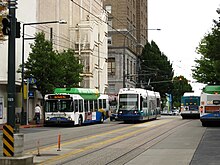
Line T is one.6 miles (ii.half dozen km) long and runs at-class in mixed traffic besides as an exclusive lane for its single-track section. Trains travel w from an operations and maintenance facility located on E 25th Street nearly McKinley Avenue to the line's southern terminus at Tacoma Dome Station.[75] Tacoma Dome Station has a unmarried side platform for Link trains, located south of the ii,283-space parking garage and jitney station and n of the Sounder commuter rail and Amtrak station.[76] The single-track railway continues west in the median of East 25th Street and crosses under Interstate 705 before reaching Southward 25th Street station on the south adjourn of the street well-nigh A Street.[77]
Line T trains then plough north onto Pacific Artery and travel in the median for several blocks parallel to Interstate 705, splitting into ii tracks later South 21st Street.[62] [78] The dual-tracked railway reaches Wedlock Station/South 19th Street station, located adjacent to the historic Union Station (now a courthouse), the Washington Land History Museum, the Museum of Glass, and the University of Washington, Tacoma campus.[79] Near the Tacoma Art Museum, the tracks leave Pacific Avenue and travel northwest onto Commerce Street higher up Tollefson Plaza, crossing over the Prairie Line Trail and stopping at S 15th Street near the Greater Tacoma Convention and Trade Center.[57] [eighty] Link trains then travel north on Commerce Street, a major bus transfer area for Pierce Transit, and share its lanes with mixed traffic.[52] Trains stop at South 11th Street in the center of Downtown Tacoma before merging into a unmarried track at Due south 9th Street.[78] The line currently terminates at Theater District station,[77] located well-nigh Tacoma'south urban center hall and the celebrated Pantages and Rialto theaters.[81]
Stations [edit]
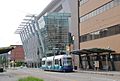
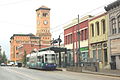
The six stations on Line T are built with 90-foot (27 m) platforms that are long enough to accommodate one auto at a time, but were designed to support further expansion for multi-car trains.[82] Each station features shelters, seating, rider information, and public artwork that reflects the history of the surrounding neighborhood.[83] [84]
| Station[78] | Image | Opened | Connections and notes[78] |
|---|---|---|---|
| Tacoma Dome Station | | August 22, 2003 [85] | Connections to Sounder commuter rail and Audio Transit Limited |
| Southward 25th Street | | August 22, 2003 [85] | |
| Union Station/Southward 19th Street | | August 22, 2003 [85] | |
| Convention Center/South 15th Street | | Baronial 22, 2003 [85] | |
| Commerce Street/South 11th Street | | September xv, 2011 [69] | |
| Theater District/South 9th Street | | August 22, 2003 [85] |



Service [edit]
Line T trains run 17 hours per day on weekdays, from 5:00 am to ten:12 pm, fourteen hours per twenty-four hours on Saturdays, seven:48 am to ten:12 pm, and 8 hours per 24-hour interval on Sundays and holidays, from 9:48 am to six:00 pm.[17] [86] Trains operate at a frequency of every 12 minutes during the 24-hour interval on weekdays and Saturdays and every 24 minutes on Sundays, holidays, and during early morning and evening service on weekdays.[17] Operating hours are occasionally extended into the late evening for events at the Tacoma Dome, with trains running more frequently.[17] [87]
Line T takes approximately x minutes to traverse its entire route from the Tacoma Dome Station to the Theater District.[88] A maximum of two trains are able to operate on Line T due to the single-track section betwixt Spousal relationship Station and Tacoma Dome Station.[88] Prior to the opening of Commerce Street/Due south 11th Street station in 2011, trains ran at frequencies of 10 minutes during the day and 20 minutes during other hours.[17]
Ridership [edit]
Line T carried a total of 934,724 passengers in 2019, averaging 3,109 riders on weekdays.[1] Ridership on the line fluctuates based on several factors, including special events scheduled at the Tacoma Dome or hosted in Downtown Tacoma, and class times at the University of Washington campus in Tacoma.[89] Line T patronage peaked at 1.024 million annual riders in 2012, but has since declined due to the loss of several major downtown employers.[90] Total ridership from 2017 to 2018 declined by 7.6 percentage year over year due to the closure of the Tacoma Dome for renovations, but rebounded in 2019.[1] Ridership fell to under a half-meg total passengers in 2020 due to the COVID-19 pandemic.[91]
| Twelvemonth | Ridership | %± |
|---|---|---|
| 2003 | 266,600 | — |
| 2004 | 794,582 | +198.0% |
| 2005 | 884,895 | +eleven.four% |
| 2006 | 885,397 | +0.1% |
| 2007 | 919,013 | +3.8% |
| 2008 | 930,632 | +1.3% |
| 2009 | 889,320 | −4.4% |
| 2010 | 871,793 | −ii.0% |
| 2011 | 972,429 | +11.5% |
| 2012 | one,024,053 | +5.3% |
| 2013 | ane,000,316 | −two.3% |
| 2014 | 963,694 | −iii.7% |
| 2015 | 980,705 | +ane.viii% |
| 2016 | 937,885 | −3.6% |
| 2017 | 972,405 | +3.seven% |
| 2018 | 897,642 | −7.seven% |
| 2019 | 934,724 | +4.1% |
| 2020 | 433,247 | −53.six% |
| Sources: Sound Transit, APTA[92] [93] | ||
Fares [edit]
Fares are not charged on Line T, with operating costs covered by Sound Transit and a $29,000 annual subsidy from the Tacoma Business Improvement Surface area.[94] Sound Transit chose to launch the service without fares due to the cost of collection exceeding projected revenues.[62] A upkeep shortfall acquired past the late 2000s recession caused Sound Transit to consider a $ane fare in 2010, but the decision was pushed to a later engagement.[95] [96]
The Sound Transit Board approved a $1 base of operations fare in September 2013, taking effect the following yr and rising to $i.fifty in 2016, to heighten enough revenue to comprehend fare enforcement and installation of ticket vending machines.[97] The proposed fare was unpopular with riders, business owners, and local boosters due to the potential bear upon on tourism, with a predicted 25 percent drop in ridership.[98] [99] Earlier the fare could take upshot, the Downtown Tacoma Business Improvement Area agreed to subsidize the difference in revenue past paying $29,000 annually to Sound Transit for two years of gratuitous fares.[100] [101]
The Tacoma Business Improvement Expanse agreed to renew its $29,000 annual subsidy in April 2016, covering the equivalent of a $two fare until the opening of the Hilltop extension.[102] A $i.50 adult fare and $0.75 senior and disabled fare is planned to exist collected kickoff in 2022.[103] [104]
Rolling stock and equipment [edit]
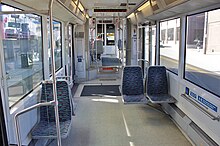
Interior of a Škoda ten T articulated streetcar run on Line T
The current Line T fleet consists of three low-flooring articulated Škoda ten T streetcars, numbered 1001 to 1003.[89] They were manufactured in the Czech Republic by Škoda Transportation and are identical to cars used past the Portland Streetcar system in Portland, Oregon.[46] [85] [105] The cars are 66 feet (twenty.12 m) long, 8 feet (2.44 g) wide, and have two articulation joints, between which is a low-floor key section.[106] [107] Each vehicle has thirty seats and can deport an additional 85 passengers at crush load.[107] The cars and platforms are built for level boarding, with a mechanical wheelchair ramp deployed past operators upon request.[108]
The Škoda cars each weigh 31 curt tons (28,123 kg; 28 long tons) and can reach a top speed of 25 miles per hour (40 km/h).[56] They are unable to be coupled and draw their electric power from overhead catenary that is energized at 750 volts direct electric current.[82] The cars are stored and maintained at an operating base of operations located east of Tacoma Dome Station and Freighthouse Square.[46] The system has several operational differences from the Line one fleet, including electric systems and its minimum turning radius, that makes the two lines incompatible with each other.[82]
In November 2017, Sound Transit ordered 5 Liberty-model streetcars from the Brookville Equipment Corporation, at a cost of $26.5 million, for apply on the hereafter Hilltop extension. At the time of the order's being placed, the 34-seat cars were projected to be delivered in late 2020 and early 2021, merely were delayed to March 2022.[109] [110] The contract includes an option to order five additional cars.[111] [112]
Future expansions [edit]
Hilltop Extension [edit]

Map of Line T and the Hilltop expansion (in blue)
A two.4-mile-long (3.9 km) extension of Line T from Downtown Tacoma to the Stadium District and Hilltop neighborhood west of downtown is nether construction.[104] The projection includes six stations and will run north on Stadium Mode, west on Partition Street to Tacoma General Hospital, and south on Martin Luther King Jr. Way to South 19th Street well-nigh St. Joseph Medical Center.[113] [114] Each station volition take decorative canopies designed by Tacoma artist Kenji Hamai Stoll.[115]
The Hilltop Extension was approved past voters as part of the Audio Transit 2 ballot mensurate in 2008 and is estimated to toll $217 million, primarily paid for by local funding and federal grants.[116] [117] Structure began with a groundbreaking in Nov 2018 and track laying in June 2019 under the direction of Walsh Structure.[113] [118] As of March 2021[update], structure is 75 per centum complete, including most trackwork and installation of catenary poles.[115] Information technology is expected to open in early on 2023,[119] with trains running on ten-infinitesimal headways during weekdays.[113] [120] The extended Line T volition run mostly in mixed traffic and is projected to increase daily ridership to over ten,800 by 2035.[121] As part of the project, the South 9th Street/Theater District station will exist relocated one block north to the Sometime Urban center Hall.[120]
[edit]
An extension beyond the Hilltop neighborhood to the Tacoma Community Higher campus in western Tacoma was funded by the Sound Transit three ballot measure, approved by voters in 2016, and is scheduled to open in 2041.[122] [123] The three.5-mile-long (5.half dozen km) extension would use Due south 19th Street and cease at half dozen stations, carrying approximately 18,000 daily riders and costing up to $478 meg.[124] Train frequency would be increased to six minutes during peak periods and a section of the original line near Union Station would be double-tracked.[125]
References [edit]
- ^ a b c "Q4 2019 Service Delivery Quarterly Performance Report" (PDF). Sound Transit. February 27, 2020. Retrieved July 30, 2020.
- ^ Wilma, David (January eighteen, 2003). "Tacoma Street Railway inaugurates service on May 30, 1888". HistoryLink . Retrieved Jan 1, 2019.
- ^ Tacoma Link Expansion Ecology Evaluation: Historic and Archaeological Resources Technical Report (PDF) (Report). Sound Transit. June 2015. pp. 6–7. Archived from the original (PDF) on September 21, 2015. Retrieved January 1, 2019.
- ^ Kremer, Lisa (February 17, 2001). "Streetcar's era concluded in 1938". The News Tribune. p. SL4.
- ^ a b Corvin, Aaron (Baronial 22, 2003). "Link'due south debut stirs memories of 1st streetcars". The News Tribune. p. A1.
- ^ a b Turner, Joseph (November 3, 1992). "Plan may add rail lines to please Pierce County". The News Tribune. p. B1.
- ^ a b Foster, Heath (May 19, 1996). "Backers say tiny light rail line would tote large benefits". The News Tribune. p. A1.
- ^ Card, Skip (June 23, 2002). "Tacoma Downtown turns around". The News Tribune. p. A1.
- ^ Schaefer, David (September 10, 1994). "Costs put on options for regional system of light rail, buses". The Seattle Times. p. A9.
- ^ Schaefer, David (February 12, 1995). "On the correct track? Questions, answers to the $half-dozen.vii billion proposal". The Seattle Times. p. A1.
- ^ Schaefer, David (January 11, 1996). "RTA set to unveil new plan: rapid transit proposal's price, telescopic downsized". The Seattle Times. p. A1. Retrieved January 1, 2019.
- ^ "The Regional Transit Arrangement Proposal" (PDF). Central Puget Sound Regional Transit Authorisation. February 1995. pp. 7–8. Archived from the original (PDF) on September 30, 2015. Retrieved January 1, 2019.
- ^ "Audio Move: Launching a Rapid Transit Organization for the Puget Sound Region" (PDF). Sound Transit. May 31, 1996. pp. 15–17, 23. Archived (PDF) from the original on March 4, 2016. Retrieved January i, 2019.
- ^ Flash, Cynthia (Nov 7, 1996). "Key RTA issues all the same demand to exist settled". The News Tribune. p. A1.
- ^ Abe, Debby (October 26, 1997). "Coffee, newspaper and bus to become: Tacoma dedicates its new transit center". The Seattle Times. p. B1.
- ^ "Service gives downtown commuters parking, ride". Seattle Post-Intelligencer. February 16, 1998. p. B2.
- ^ a b c d due east "2018 Service Implementation Plan" (PDF). Sound Transit. December 2017. pp. 111–115. Retrieved January 1, 2019.
- ^ Eckart, Kim (March 30, 1998). "Light runway is coming into focus". The News Tribune. p. B1.
- ^ Turner, Joseph (Oct 19, 1998). "Tacoma: Hereafter rail service on calendar". The News Tribune. p. B2.
- ^ Eckart, Kim (March 26, 1998). "RTA maps options in Tacoma". The News Tribune. p. A1.
- ^ Eckart, Kim (June 16, 1998). "Watch for trains on either Pacific or Commerce". The News Tribune. p. B1.
- ^ Eckart, Kim (November 4, 1998). "Track costs zoom over estimates". The News Tribune. p. B1.
- ^ Eckart, Kim (Jan 27, 1999). "Tacoma council decides to delay office of low-cal-rail route decision". The News Tribune. p. A16.
- ^ "Tacoma Link light rail takes major step forrard as Audio Transit Lath identifies road and station locations" (Press release). Sound Transit. February 12, 1999. Retrieved Jan ane, 2019.
- ^ Foster, George (February 19, 1999). "Tacoma separate over route of downtown rail". Seattle Post-Intelligencer. p. C1.
- ^ Callaghan, Peter (April 20, 1999). "Logic aside, our calorie-free runway should be treated every bit toy". The News Tribune. p. B1.
- ^ Eckart, Kim (May 26, 1999). "Urban center wants light rail to run on Commerce". The News Tribune. p. B1.
- ^ "Sound Transit Motion No. M99-28" (PDF). Sound Transit. July 8, 1999. Archived from the original (PDF) on March 4, 2016. Retrieved Jan 1, 2019.
- ^ Quigg, David (June 18, 1999). "Free rides probable on Tacoma light rail". The News Tribune. p. A1.
- ^ Eckart, Kim (February 3, 2000). "Audio Transit stations will reflect their surrounding neighborhoods". The News Tribune. p. B1.
- ^ Szymanski, Jim (September 25, 2000). "Construction pinches Freighthouse". The News Tribune. p. B1.
- ^ "Opening of expanded Tacoma Dome Station, kickoff of Tacoma Link calorie-free rail structure to be celebrated" (Printing release). Sound Transit. October 6, 2000. Retrieved January 1, 2019.
- ^ Eckart, Kim (January 27, 2000). "Sound Transit to adjust light-rail line to avert buried telephone equipment". The News Tribune. p. B4.
- ^ Modeen, Martha (December 10, 2000). "Final light-rail decisions due". The News Tribune. p. B1.
- ^ Quigg, David (February nine, 2001). "Tacoma contract for low-cal rails goes to Gary Merlino". The News Tribune. p. B1.
- ^ "Construction to brainstorm forth the Tacoma Link low-cal rails line" (Printing release). Sound Transit. July nine, 2001. Retrieved January 1, 2019.
- ^ "Link calorie-free rail construction begins in Tacoma" (Press release). Audio Transit. January 22, 2001. Retrieved Jan ane, 2019.
- ^ Modeen, Martha (June 18, 2001). "Construction to brainstorm on Link light-runway plaza project". The News Tribune. p. B1.
- ^ Modeen, Martha (July 16, 2001). "Tacoma project's costs are soaring". The News Tribune. p. A1.
- ^ Corvin, Aaron (November 26, 2001). "Tacoma on runway to get lighter version of light rail". The News Tribune. p. A1.
- ^ Corvin, Aaron (December 12, 2001). "Officials hail start of Link in Tacoma". The News Tribune. p. B1.
- ^ Quigg, David (Dec 14, 2001). "Sound Transit to run city line". The News Tribune. p. B1.
- ^ Hagey, Jason (February 7, 2002). "Along Link route, merchants feeling pinch". The News Tribune. p. A10.
- ^ Corvin, Aaron (Apr 13, 2002). "More detours downtown". The News Tribune. p. B1.
- ^ Barker, Jeffery M. (September 4, 2002). "Tacoma'south calorie-free rail transit cars make it". Seattle Mail service-Intelligencer. p. B1. Retrieved January v, 2019.
- ^ a b c Corvin, Aaron (November 3, 2002). "Streetcars ready for viewing". The News Tribune. p. B1.
- ^ Quigg, David (January 23, 2003). "Tacoma Link streetcar takes Seattle road trip". The News Tribune. p. A1.
- ^ Hagey, Jason (February 7, 2002). "Legal fight threatens to tiresome light runway". The News Tribune. p. A1.
- ^ Lindblom, Mike (August 8, 2002). "Qwest, non Sound Transit, must pay to motility wires". The Seattle Times. p. B2.
- ^ Quigg, David; Wickert, David (January 31, 2003). "Big trains may yield to progress, light rail". The News Tribune. p. A1.
- ^ Corvin, Aaron (March 19, 2002). "Sound Transit faces rubber bug with light track". The News Tribune. p. A1.
- ^ a b Corvin, Aaron (February 15, 2003). "Big day for Commerce, Pierce Transit". The News Tribune. p. B1.
- ^ Corvin, Aaron (April 8, 2003). "Rail line's concluding weld a big stride". The News Tribune. p. B1.
- ^ Leventis, Angie (June nineteen, 2003). "Agency takes Link out for a spin". The News Tribune. p. B1.
- ^ Corvin, Aaron (August 6, 2003). "Streetcar scraped up in 1st mishap". The News Tribune. p. B1.
- ^ a b Lindblom, Mike (August 23, 2003). "Sound Transit starts small with Tacoma Link system". The Seattle Times. p. B1. Retrieved January 1, 2019.
- ^ a b Hadley, Jane (Baronial 22, 2003). "Tacoma'due south light rails—one.half-dozen historic miles". Seattle Post-Intelligencer. p. B1. Retrieved January one, 2019.
- ^ Corvin, Aaron (August 23, 2003). "Tacoma Link makes its debut". The News Tribune. p. A1. Archived from the original on September 1, 2003. Retrieved January i, 2019.
- ^ "Sound Transit'due south Tacoma Link off to flying starting time; ridership exceeds 2010 projections" (Press release). Audio Transit. September 11, 2003. Retrieved Jan 1, 2019.
- ^ Corvin, Aaron (April 28, 2004). "City's streetcar organisation hits 500,000-rider marking". The News Tribune. p. B2.
- ^ Matthews, Todd (December 8, 2004). "1 Million Served: Tacoma Link light track celebrates milestone ridership". Tacoma Daily Index . Retrieved January 2, 2019.
- ^ a b c Corvin, Aaron (Baronial 17, 2003). "Future link: Tacoma or bust". The News Tribune. p. A15.
- ^ Carson, Rob (October 17, 2002). "Urban center, tribe written report light-rail bargain". The News Tribune. p. B1.
- ^ Hadley, Jane (March 24, 2004). "Light runway extension studied in Tacoma". Seattle Post-Intelligencer. p. B4. Retrieved January iv, 2019.
- ^ Corvin, Aaron (March 19, 2004). "Four options for extending Tacoma's lite-rails line". The News Tribune. p. B1.
- ^ Parsons Brinckerhoff (March 2005). Sound Transit Long-Range Plan Update Issue Paper South.6: Potential Tacoma Link Extension – East (PDF) (Report). Audio Transit. Retrieved May four, 2016.
- ^ Corvin, Aaron (March 25, 2005). "East could meet west on light rail". The News Tribune. p. A1.
- ^ Hagey, Jason (June thirteen, 2007). "An idea with legs, and tracks". The News Tribune. p. A1.
- ^ a b "Tacoma Link Commerce Street Station opens tomorrow" (Press release). Audio Transit. September xiv, 2011. Retrieved January 1, 2019.
- ^ Callaghan, Peter (September 7, 2011). "New Commerce Street link stations are close to completion". The News Tribune.
- ^ Callaghan, Peter (September 9, 2011). "New Commerce Street Link Station will exist open for passengers Sept. xv". The News Tribune.
- ^ Netzler, Kat (September 18, 2019). "Link lite rail debuts line colors". The Platform. Audio Transit. Retrieved September 18, 2019.
- ^ Sailor, Craig (October x, 2019). "See ya, Tacoma Link. Audio Transit retitles streetcar line with new colorful name". The News Tribune . Retrieved Oct 10, 2019.
- ^ Shaner, Zach (April nine, 2020). "New line names coming in 2021". The Platform. Sound Transit. Retrieved April 9, 2020.
- ^ Corvin, Aaron (August iv, 2002). "Light rail, heavy expectations: Supporters and critics say the lite rail projection is crucial to Sound Transit's credibility". The News Tribune. Tacoma, Washington. p. A1.
- ^ "The Tacoma Dome Station". Pierce Transit. Archived from the original on November 3, 2011. Retrieved Jan ii, 2019.
- ^ a b "Sound Transit Motion No. M99-5" (PDF). Audio Transit. February 11, 1999. Archived from the original (PDF) on March four, 2016. Retrieved Jan 2, 2019.
- ^ a b c d "Tacoma Link light rail: Fact Canvas" (PDF). Sound Transit. June 2012. Retrieved Jan 2, 2019.
- ^ Larsen, Jeff (Nov xiii, 2003). "Keep coming back: The urban center's on a roll". Seattle Post-Intelligencer. p. 4.
- ^ Callaghan, Peter (March xix, 2013). "Prairie Line will add welcome green to a gray cityscape". The News Tribune.
- ^ Woolston, Deborah (July iv, 2002). "Museum of Drinking glass: A bridge to Tacoma's cultural hereafter". Kitsap Sun . Retrieved January 2, 2019.
- ^ a b c Parsons Brinckerhoff (March 2005). Sound Transit Long Range Plan Update Issue Paper Due south.1: Tacoma Link Integration with Cardinal Link (PDF) (Report). Sound Transit. pp. 5–7. Retrieved January 1, 2019.
- ^ "Tacoma Link Expansion: Projection Overview" (PDF). Sound Transit. July 2015. Retrieved January two, 2019.
- ^ Stephens, Terry (September 20, 2001). "Sound Transit seeks success in Tacoma". Seattle Daily Journal of Commerce . Retrieved January 2, 2019.
- ^ a b c d e f Burrows, Alyssa (Jan 26, 2004). "Audio Transit'south Tacoma Link light rails arrangement begins operation on August 22, 2003". HistoryLink . Retrieved Jan 1, 2019.
- ^ "Ride the Mode Transit Guide: Route Maps & Schedules" (PDF). Audio Transit. September 2018. p. 23. Retrieved January 1, 2019.
- ^ Ellouk, Bernard (Oct 30, 2017). "Sound Transit volition make it easier to get to Garth Brooks concerts". KING v News. Retrieved Jan one, 2019.
- ^ a b "Audio Transit Service Standards and Performance Measures, 2018 Edition" (PDF). Sound Transit. 2018. p. 21. Retrieved January 1, 2019.
- ^ a b "2019 Service Implementation Plan" (PDF). Sound Transit. November 2018. pp. 58, 213. Retrieved Jan four, 2019.
- ^ Lynn, Adam (December 21, 2016). "Tacoma Link ridership heads downhill". The News Tribune. p. A1. Retrieved January 1, 2019.
- ^ "Q4 2020 Service Delivery Quarterly Functioning Report" (PDF). Sound Transit. February 25, 2021. Retrieved March 4, 2021.
- ^ "Service planning and ridership documents". Audio Transit. Retrieved Jan 1, 2019.
- ^ "Transit Ridership Written report Fourth Quarter 2003" (PDF). American Public Transportation Association. Baronial 3, 2004. p. 33. Retrieved December 11, 2013.
- ^ Lynn, Adam (Apr 29, 2016). "Tacoma Link rides to remain gratis indefinitely". The News Tribune. p. A10. Retrieved January 1, 2019.
- ^ Kamb, Lewis (September 27, 2010). "Costless Tacoma Link rides over?". The News Tribune. p. A1.
- ^ Matthews, Todd (Oct 19, 2010). "Complimentary Passage: Sound Transit holds off on charging for downtown Link light rail service". Tacoma Daily Index . Retrieved January two, 2019.
- ^ Carson, Rob (September 27, 2013). "Lath OKs $1 adult Link fares next year". The News Tribune. p. A1.
- ^ Carson, Rob (September xx, 2013). "Link riders blast programme to accuse passengers". The News Tribune. p. A3.
- ^ Carson, Rob (August 12, 2013). "Transit considering fares for Link riders". The News Tribune. p. A1.
- ^ Cafazzo, Debbie (May 19, 2014). "Downtown group offers to pay Link riders' way". The News Tribune. p. A1.
- ^ "Business Comeback Area to pay to delay Tacoma Link fares for 2 years" (Press release). Sound Transit. May 22, 2014. Retrieved January 2, 2019.
- ^ Lynn, Adam (April 27, 2016). "Bargain to keep Tacoma Link rides gratuitous for now nearing blessing". The News Tribune. p. A3. Retrieved Jan ii, 2019.
- ^ Needles, Allison (July 3, 2021). "Riders will have to pay to utilize the Tacoma Link in 2022. Here'due south what it could cost". The News Tribune . Retrieved July 3, 2021.
- ^ a b "Tacoma Link to remain fare free until Hilltop extension opens" (Press release). Sound Transit. April 28, 2016. Retrieved Apr 28, 2016.
- ^ "How it's built: Vehicles". Sound Transit. Archived from the original on April 8, 2016. Retrieved January 1, 2019.
- ^ "Skoda breaks into the urban market". Railway Gazette International. April 1, 2001. Retrieved January 1, 2019.
- ^ a b "The Tacoma Link Light Rail Vehicles are Coming!" (Press release). Sound Transit. July 25, 2002. Retrieved Jan 1, 2019.
- ^ "Transit accessibility". Sound Transit. Retrieved Jan 2, 2019.
- ^ "Projection Update: Construction continues through holidays to open up Hilltop Tacoma Link in 2022". Audio Transit. December 1, 2021. Retrieved January 3, 2022.
- ^ Metzger, Katie (March xxx, 2022). "Fresh pics: New low-cal rail vehicle arrives in Tacoma". The Platform. Sound Transit. Retrieved March 30, 2022.
- ^ "Sound Transit orders five additional light rails vehicles for Tacoma Link Extension to Stadium, Hilltop neighborhoods" (Press release). Sound Transit. Nov 16, 2017. Retrieved January 1, 2019.
- ^ Vantuono, William C. (December 7, 2017). "Sound Transit finalizes Brookville contract". Railway Age . Retrieved January 1, 2019.
- ^ a b c Sailor, Craig (Nov 17, 2018). "Hilltop street motorcar'southward two.4 mile road extension breaks ground Monday". The News Tribune . Retrieved November 18, 2018.
- ^ "Audio Transit Board selects alignment, stations for Tacoma Link Expansion" (Press release). Audio Transit. Nov 19, 2015. Retrieved May 4, 2016.
- ^ a b Sailor, Craig (March 24, 2021). "Sound Transit's Hilltop trolley extension 75% finished. Then when can you hop a ride?". The News Tribune . Retrieved March 31, 2021.
- ^ Nunnally, Derrick (Oct 26, 2015). "Tacoma Link expansion gets $15 meg in federal money". The News Tribune . Retrieved January 1, 2019.
- ^ "Audio Transit breaks ground on Hilltop Tacoma Link Extension" (Press release). Sound Transit. November 19, 2018. Retrieved January ane, 2019.
- ^ Crewman, Craig (June 19, 2019). "They're laying rail for Tacoma's streetcar extension. They're also digging up relics". The News Tribune . Retrieved June 20, 2019.
- ^ "Hilltop Tacoma Link opening update". The Platform. Audio Transit. February 10, 2022. Retrieved February 20, 2022.
- ^ a b "Tacoma Link Expansion: Project Overview" (PDF). Audio Transit. November 2015. Archived from the original (PDF) on June 4, 2016. Retrieved May iv, 2016.
- ^ Nunnally, Derrick (July 20, 2015). "Proposed Link stops open for review". The News Tribune. p. A1. Retrieved December two, 2018.
- ^ Lindblom, Mike (Nov 14, 2016). "Where Sound Transit 3 projects could speed upwardly or slow down". The Seattle Times. p. B1. Retrieved February 25, 2018.
- ^ Needles, Allison (August 9, 2021). "Sound Transit has $6.v billion ST3 budget gap. What does that mean for Tacoma projects?". The News Tribune . Retrieved August xiii, 2021.
- ^ "Tacoma preps for light runway expansion". Seattle Daily Journal of Commerce. November 8, 2017. Retrieved January 2, 2019.
- ^ "Tacoma Link Extension to Tacoma Customs Higher" (PDF). Sound Transit 3 Draft Programme. Audio Transit. March 29, 2016. Retrieved May four, 2016.
External links [edit]
Route map:
KML is from Wikidata
-
 Media related to Tacoma Link at Wikimedia Commons
 - Tacoma Link schedule
- Tacoma Link Expansion: Hilltop Extension
Source: https://en.wikipedia.org/wiki/Line_T_%28Sound_Transit%29
0 Response to "Bus Route From Tacoma Community College to Art Museum Tacoma"
Post a Comment